How it works.
Five stations. You at the center. Frame the question, approve the plan, watch the team run, read the draft, then steer until the work is yours.
Thinking Partner: shape the project plan before anything runs
You don't plan alone. As you talk, your structured project plan takes shape right beside the conversation, so you watch it develop in real time. The Thinking Partner asks the questions you didn't know to ask about scope, audience, what 'good' looks like, and what context to bring. A live confidence score shows how close the plan is to having what Calafai needs to deliver a great working report, so you can see when there's enough to start. You decide when to begin.
Conversational planning. Your pace, your turns
The Thinking Partner probes scope, audience, success criteria, blind spots
Upload context as it surfaces: existing research, financials, competitor info
Voice or text. However the thinking comes
Pre-configured project types are starting points, not constraints
A live confidence score tracks readiness, so you know when there's enough to run
Calafai never starts a run without your green light
Service plan: approve the scope and what evidence is in
Before any agent runs, you see the task plan and what evidence each task requires. If a task needs source material you haven't provided, you upload it, reframe the task into something sourceable, or drop it. This is the gate that prevents fabricated answers. No run starts on evidence that doesn't exist.
Task plan generated from your project plan, with explicit evidence requirements per task
An independent Evidence Auditor checks reachability before the run starts
For gaps, you choose: upload data, reframe the task, or drop it
Your evidence decisions shape the scope of the run
The discipline that keeps the output sourced, not invented
Calafai Team: runs in parallel, scored in real time, challenged before delivery
Calafai assembles the right team from our roster of custom-built agents across strategy, research, finance, design, and operations. They run in parallel along the dependency graph. Every deliverable is multi-dimensionally scored mid-run; if quality dips below your intent target, Calafai pauses and asks you to decide: go deeper or continue. Before anything reaches you, a separate agent adversarially challenges the conclusions, tests for gaps and weak evidence, and surfaces what needs to be addressed.
The best team for your project, picked from our roster of custom-built Calafai agents
Parallel execution along the dependency graph. Work moves at speed
'Your Team' panel shows who's active and what kind of work they're doing
Activity feed narrates in plain English: drafting, scoring, revising
Multi-dimensional scoring per deliverable, not a generic thumbs up/down
Source claims graded by reliability tier during the run
Mid-run quality gate: go deeper or continue. Your call
Adversarial review by an independent agent that challenges the conclusions
Tests for gaps, weak evidence, and blind spots before delivery
Step away or stay close. Either way you see what's happening
Draft: structured to be argued with, not accepted
What lands in your workspace isn't a polished final report. It's a structured draft built to be interrogated: every claim anchored to its source, quality scores visible per section, and the adversarial critique surfaced alongside the conclusions so you can see where the analysis held up and where it didn't.
BLUF headers so the conclusion is never buried
Per-claim source anchors: you always know where an assertion came from
Confidence chips on each section so you know how much to trust it
Quality scores per deliverable, not just a pass/fail at the end
Adversarial critique visible next to the analysis, not hidden in an appendix
Open questions clearly flagged rather than papered over
Implementation plan included, not just findings
Decisions: annotate, redirect, re-run. Until it's yours
Calafai doesn't ship 'final' reports. It ships drafts good enough to argue with. Annotate what you want different, or open Discuss & Refine for a real conversation about the draft. Re-run with your feedback and each iteration builds on what you steered. When it's ready, share via the branded client portal where comments and approvals stay in the system.
Annotate inline: mark up specific sections with exactly what you want changed
Discuss & Refine: a conversation grounded in the draft, not a blank chat
Re-run with your feedback. Each iteration incorporates your steering
Redirect to an earlier station: step back to replan, or back to the Thinking Partner to reframe entirely
Outputs in the format your room expects: strategy memos, presentations, briefings, financial models
Branded client portal: review, comment, approve in-system. No email loops
The deliverable, and the three things you do with it.
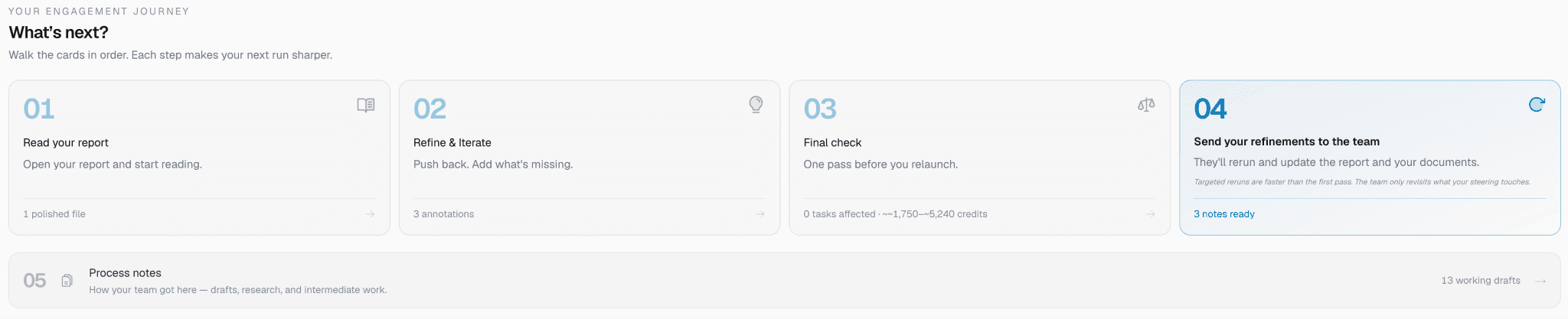
When the run completes, the report lands in your workspace alongside three follow-on deliverables: contextual feedback to steer the next iteration, an independent partner review of the conclusions, and a sequenced next-steps blueprint.
The Calafai platform: how a strategic question becomes a final report with three follow-on deliverables.

Start from an example.
Choose a starting point that matches your need. Each one is pre-configured and ready to run.
Product Strategy
Market positioning, roadmap, competitive analysis
5 deliverables
Go-to-Market
Segmentation, pricing, channel strategy, launch plan
6 deliverables
Business Transformation
Org analysis, change management, financial modeling
7 deliverables
Research Deep Dive
Multi-source research, financial modeling, sensitivity analysis
6 deliverables
Brand & Digital Presence
Brand identity, content strategy, design specification
8 deliverables
Product Design Sprint
Discovery, prototyping, UX evaluation, design system
7 deliverables
Ready to try it?
Start a conversation. Shape the plan. Steer every iteration.
Explore for FreeNo credit card required. No commitment.